BirthSkyProduct story · 4 min read
Turn a time and place into a sky to keep.
An astronomy-inspired experience that turns a time and place into a customisable star-map wallpaper.
Read the case study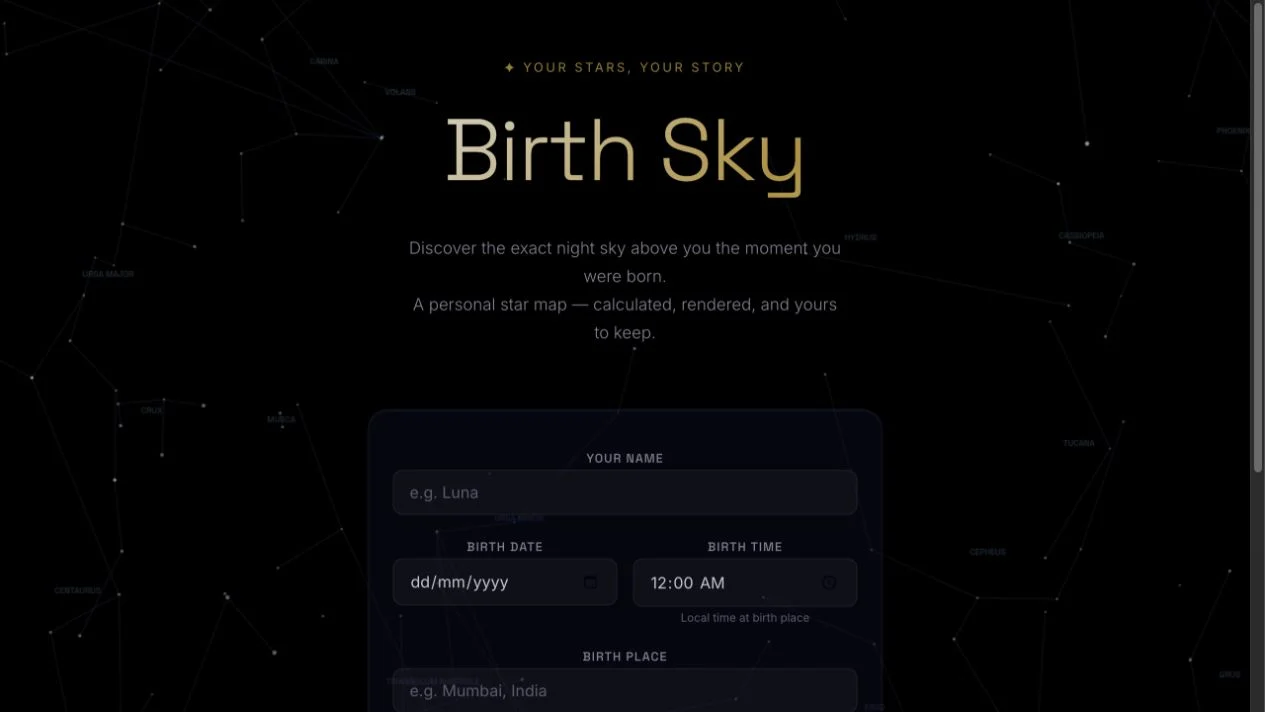
Original BirthSky interface for entering a birth date, time and place to explore the sky.
View full size ↗01 The problem
How can a technical chart become a meaningful personal object?
A star map can be a technical chart or a personal object. BirthSky connects a simple biographical prompt to a visual reveal, then gives the person control over labels and the final wallpaper format.
Designed for Person creating a personal sky keepsake. Understand the inputs and keep a result that feels personal.
User context Design assumption
Entering a meaningful date and place, then choosing a wallpaper.
- The friction
- Uncertain times can produce a precise-looking picture.
- Design implication
- Explain uncertainty and make visual annotation optional.
Example situation · illustrative scenario. Imagine choosing a meaningful date and place, then seeing the sky interpreted as something personal. The experience has to connect a precise-looking visual to understandable inputs.
02 The outcome
A personal moment, made into a keepsake.
I designed the journey from entering a time and place to adjusting a star map and exporting a wallpaper. Annotation and output choices let the person decide what belongs in the final image. Time uncertainty and data handling need to stay clear throughout.
More about the experience
- A personal opening. The original product connects a biographical prompt to a sky view.
- A result beyond the page. Wallpaper exports give the reveal a place to live.
03 The direction
The reveal starts with the input
The reveal and the keepsake are one journey. Time and place shape the view; annotation and aspect ratio shape how it is kept.
Product artifact · input, render, export
My direction. I connected the personal prompt to a customisable sky and wallpaper outputs.
Process and product scope
I organised the experience into a familiar prompt, a personal reveal, optional exploration, and a keepsake. Name, date, time, and place give the abstract sky a recognisable starting point.
The reveal needs understandable inputs. Unknown birth times, time zones, and any collection of personal details deserve clear explanations before a precise-looking image encourages confidence.
- Time + place
- core input
- 3
- documented visual modes
- 2
- wallpaper formats
- Choose
Enter the time and location.
- Reveal
See the sky rendered from those inputs.
- Make it yours
Choose labels and a visual mode.
- Keep
Export for a phone or desktop.
04 Design decisions
Make the date, place and reveal understandable.
Open a decision to see the reasoning and trade-off.
01Begin with a recognisable personal question
A short form collects the time and location before revealing the sky.
Why this matters. The input makes an otherwise abstract astronomical chart meaningful to the person requesting it.
The trade-off. Unknown birth times and historical time zones require careful explanation; a precise-looking map can still rest on uncertain inputs.
02Make annotation a choice
The result supports alternative modes and toggles for constellation lines and names.
Why this matters. A person may want to learn from the sky or simply use it as a visual keepsake.
The trade-off. Switches need clear effects without making the result feel like a complex scientific console.
03Design the output as part of the journey
Phone and desktop wallpaper downloads follow the reveal.
Why this matters. A useful result should fit where the person intends to use it.
The trade-off. Export must preserve legibility and composition across aspect ratios rather than just scale one screenshot.
05 Reflection
Make the inputs understandable enough to trust the reveal.
I would make it easier to work with an approximate birth time before adding another visual style. The result is personal, so the person should understand which inputs shaped it and what those inputs can reasonably tell them.
What I would evaluate next proposed work
- compare known dates and locations with an authoritative sky reference, including historical daylight-saving and time-zone cases.
- explain any logging before submission and make uncertain birth-time choices visible in the final result.
How much bigger? Show the difference.